
CHLIVE SOURCE
UK legal registry
Companies House
Returns legal name, company number, legal status and registry evidence for UK entities.
01 / Live Digital Product / COMPANY INTELLIGENCE PLATFORM

A company intelligence platform designed and engineered around official registry and VAT sources, transparent evidence, API integrations and reliable Flask and TypeScript workflows.
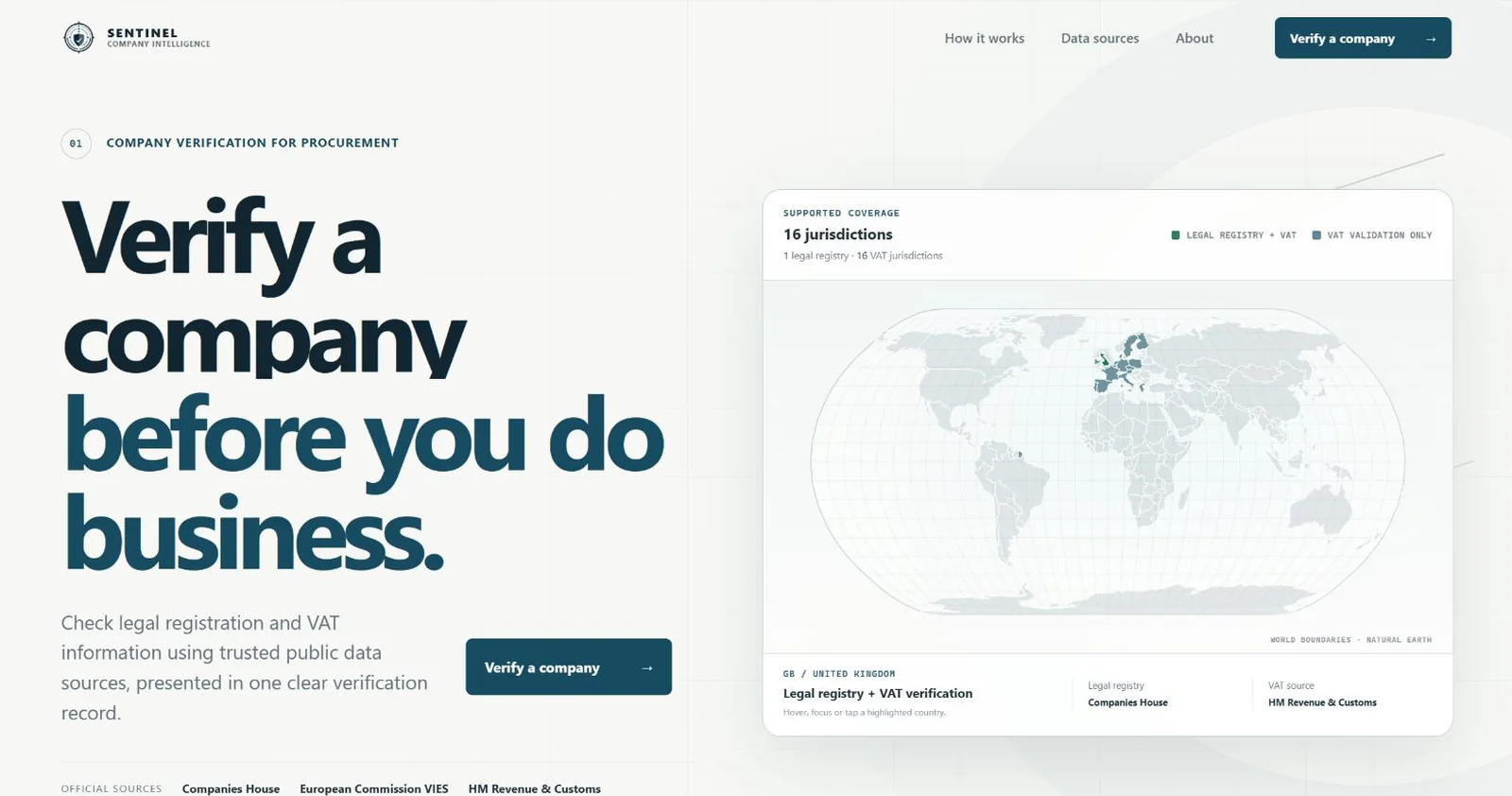
01 / OVERVIEW
SENTINEL brings official company registry and VAT verification sources into one transparent workflow for procurement and supplier review. It is a working digital product rather than a marketing-only concept: queries are routed to applicable providers, normalized into a shared evidence model and preserved as reviewable records.
02 / CHALLENGE
Company verification is fragmented. Legal identity, registration status, VAT registration, official addresses and provider availability live in different systems. The product had to make each source's role explicit, reconcile their responses without flattening their meaning and keep a technical provider failure separate from a negative conclusion about a company.
03 / SYSTEM & ROUTING
A single input can trigger different verification paths. SENTINEL reads the supplied jurisdiction, company identifier and VAT number, then queries only the official services that apply.
04 / DATA SOURCES
The interface keeps registry evidence, EU VAT validation and UK VAT validation distinct. Each provider answers a different question and retains its own environment and source context.
UK legal registry
Returns legal name, company number, legal status and registry evidence for UK entities.
EU VAT validation
Validates supported EU VAT numbers and returns registered business information when the service provides it.
UK VAT verification
Checks UK VAT registration, registered business name and VAT address. Current integration uses HMRC Sandbox test data, not production VAT verification.
05 / VERIFICATION EXPERIENCE
The workspace is designed around evidence, not a single opaque score. Input guidance, source routing, outcome reasoning, history and report generation remain part of one continuous task flow.
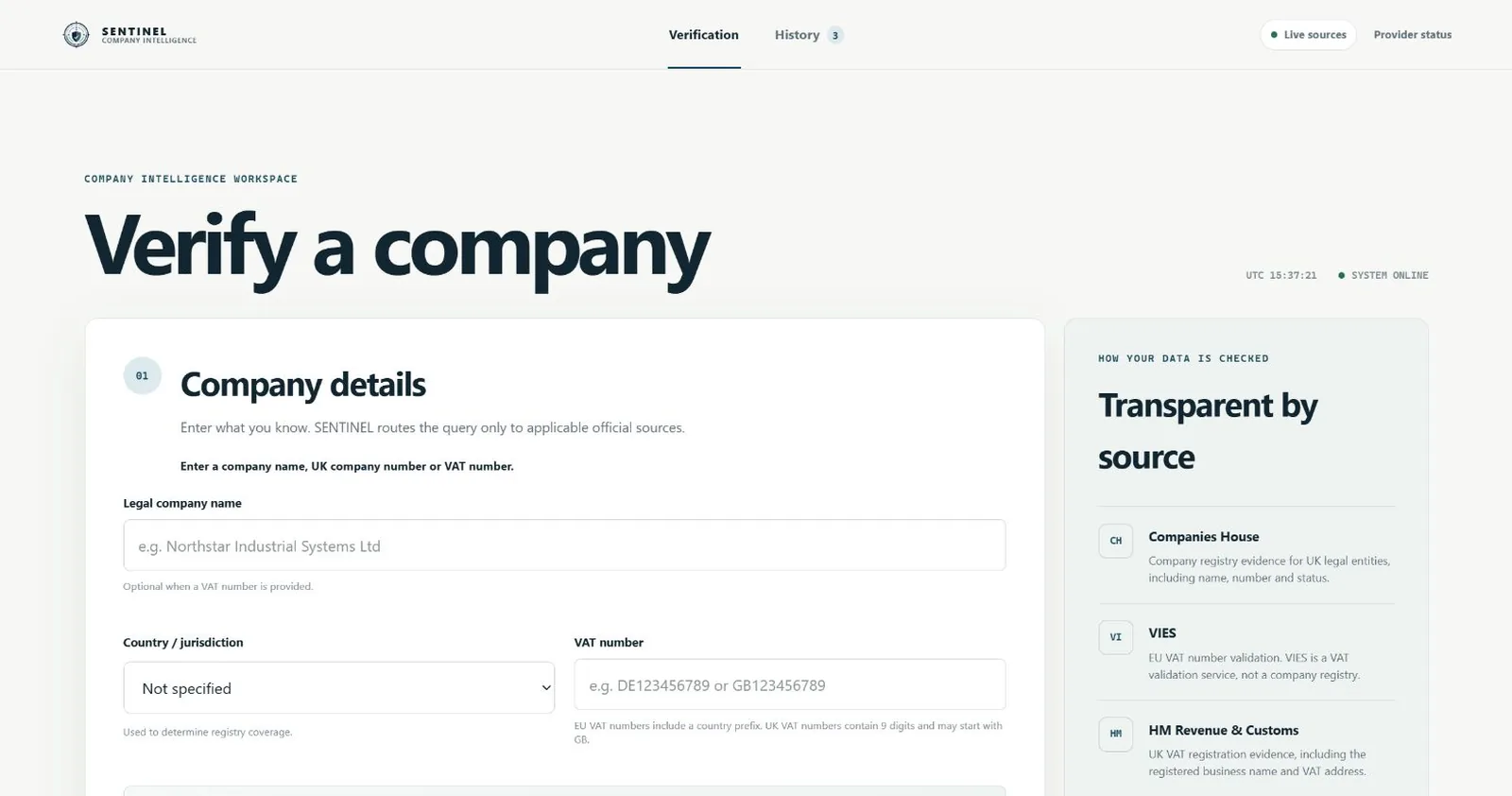
06 / CROSS-SOURCE INTELLIGENCE
Provider responses are normalized without pretending that every source verifies the same fact. Legal status remains separate from VAT status, names are compared conservatively and mismatches are surfaced for review instead of being hidden behind a generic result.
Applicable official evidence confirms the entity.
The relevant VAT service confirms registration.
Only part of the required evidence is confirmed.
Sources or identity fields need human review.
A business-negative source response, not a technical error.
The source check did not complete; no company conclusion is inferred.
07 / SOURCE TRANSPARENCY & PDF
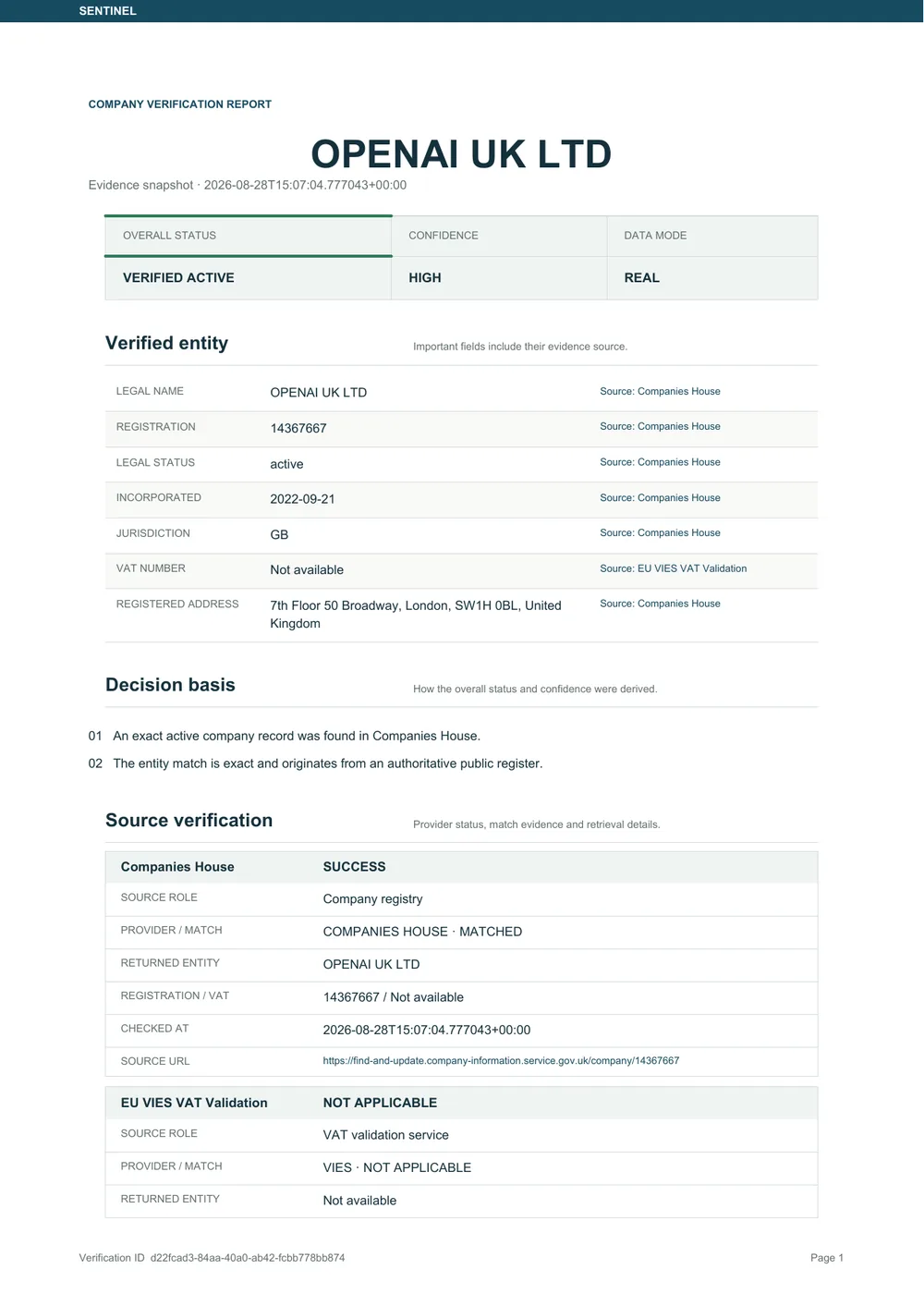
Every conclusion stays linked to its source. The UI retains provider name, source role, check time, returned data, environment and an official source URL, so the verification can be reviewed rather than accepted as a black box.
A branded PDF turns the saved verification into a portable evidence snapshot. It separates providers, records timestamps and source links, explains the decision basis and labels HMRC Sandbox responses as test data rather than production verification.
08 / UX & SEMANTIC STATES
The visual system reserves green for confirmed evidence, muted red for business-negative findings, amber for review states and a separate technical treatment for unavailable providers. Not applicable remains neutral. This keeps technical failure distinct from company risk.
09 / TECHNICAL ARCHITECTURE
The product combines a Flask application factory, provider adapters, deterministic decision logic, data normalization, persisted history and in-memory PDF generation with a strict TypeScript interface built through Vite.
Companies House, VIES and HMRC are independent adapters behind a shared verification contract.
Only providers applicable to the supplied company and VAT data are called.
Normalization supports reliable comparison without allowing fuzzy similarity alone to create a verified result.
Network and provider failures produce controlled technical states instead of false negatives.
Secrets stay in environment configuration; HMRC uses OAuth 2.0 and sensitive values are redacted from logs.
Gunicorn, versioned Vite assets and Render-compatible configuration support the live deployment.
10 / RESULT & NEXT DIRECTION
SENTINEL demonstrates end-to-end product thinking across UX/UI, Flask backend engineering, TypeScript, official API integrations, decision logic, source transparency and reporting — delivered as a responsive production application without overstating the scope of its data coverage.
Future expansion is planned around United States company registry intelligence, using official state-level business registers only where technically and legally feasible. It remains a roadmap direction, not a currently active capability.
Related capabilities
Custom dashboards, reporting interfaces, and data-aware business tools built with Flask, clean UI, and practical workflows.
Services ↗ SERVICE / 02 Web ApplicationsCustom web applications, internal systems, client portals and API-connected tools for businesses, implemented with pragmatic Python and Flask architecture.
Services ↗11 / Next Project
A kinetic product experience combining real-time 3D, controlled motion and a lightweight commerce layer.